A whirlwind month discussing youth, AI, and mental health!
Originally posted on Linkedin:
June 2026 was a whirlwind month discussing youth wellbeing and responsible AI across ACM UMAP, #DPH2026, and ACM FAccT. Across all these events, one challenge has stayed with me:
Adaptive AI is often framed as improving when systems know more, respond faster, and personalize more precisely. But for (youth) wellbeing, adaptation may only become meaningful when young people can shape how a system understands, supports, and responds to them. Three tensions I observed:
1. 𝐀𝐬𝐤𝐢𝐧𝐠 𝐛𝐞𝐟𝐨𝐫𝐞 𝐢𝐧𝐟𝐞𝐫𝐫𝐢𝐧𝐠
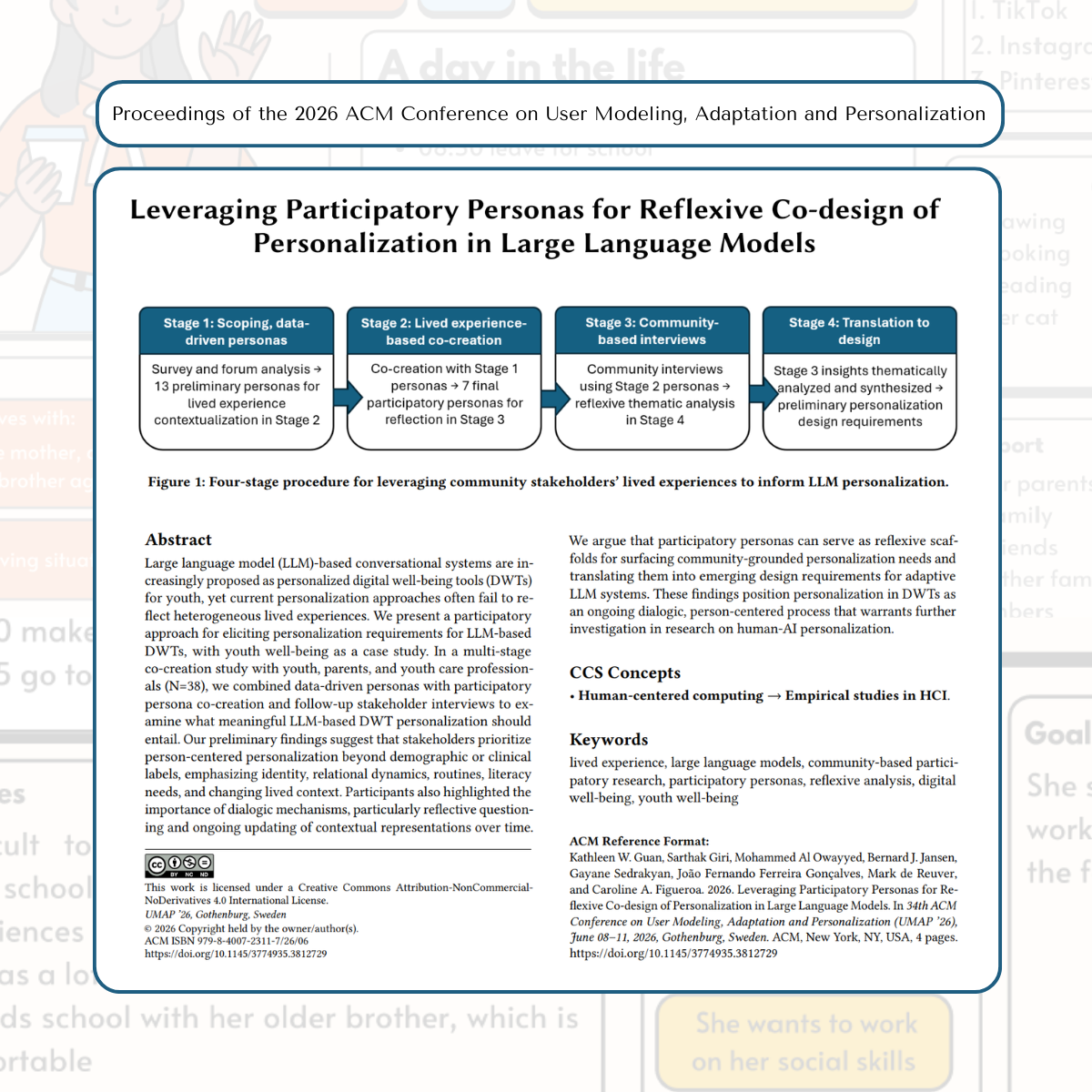
At ACM UMAP, I was grateful to present our joint work on youth-created personas for reflexive co-design of LLM personalization requirements. I enjoyedSubigya Nepal’s talk on momentarily salient adaptive systems, which also connected closely with my poster discussion about whether systems should infer a user’s context, or ask for it.
Thoughtful questions helped me understand that personalization is never only about relevance. It is also about 𝘳𝘦𝘱𝘳𝘦𝘴𝘦𝘯𝘵𝘢𝘵𝘪𝘰𝘯: what picture the system builds of a young person, and how much space they have to revise it.
2. 𝐖𝐡𝐞𝐧 𝐜𝐨-𝐝𝐞𝐬𝐢𝐠𝐧 𝐬𝐭𝐚𝐫𝐭𝐬
At #DPH2026, I was honoured to join Digital Transformations for Health Lab's panel on youth digital public health with Tobias Silberzahn, Rossana Alessandrello, and Jordi Piera Jiménez.
A question that kept coming up was: 𝘸𝘩𝘦𝘯 𝘥𝘰𝘦𝘴 𝘤𝘰-𝘥𝘦𝘴𝘪𝘨𝘯 𝘢𝘤𝘵𝘶𝘢𝘭𝘭𝘺 𝘣𝘦𝘨𝘪𝘯? Too often, young people are invited in after the system logic has already been decided: what data matters and what responses are available. What does it look like if we include youth as technical stakeholders, not just end-users?
3. 𝐖𝐡𝐚𝐭 𝐜𝐨𝐮𝐧𝐭𝐬 𝐚𝐬 𝐚 𝐬𝐚𝐟𝐞 𝐩𝐚𝐭𝐡𝐰𝐚𝐲?
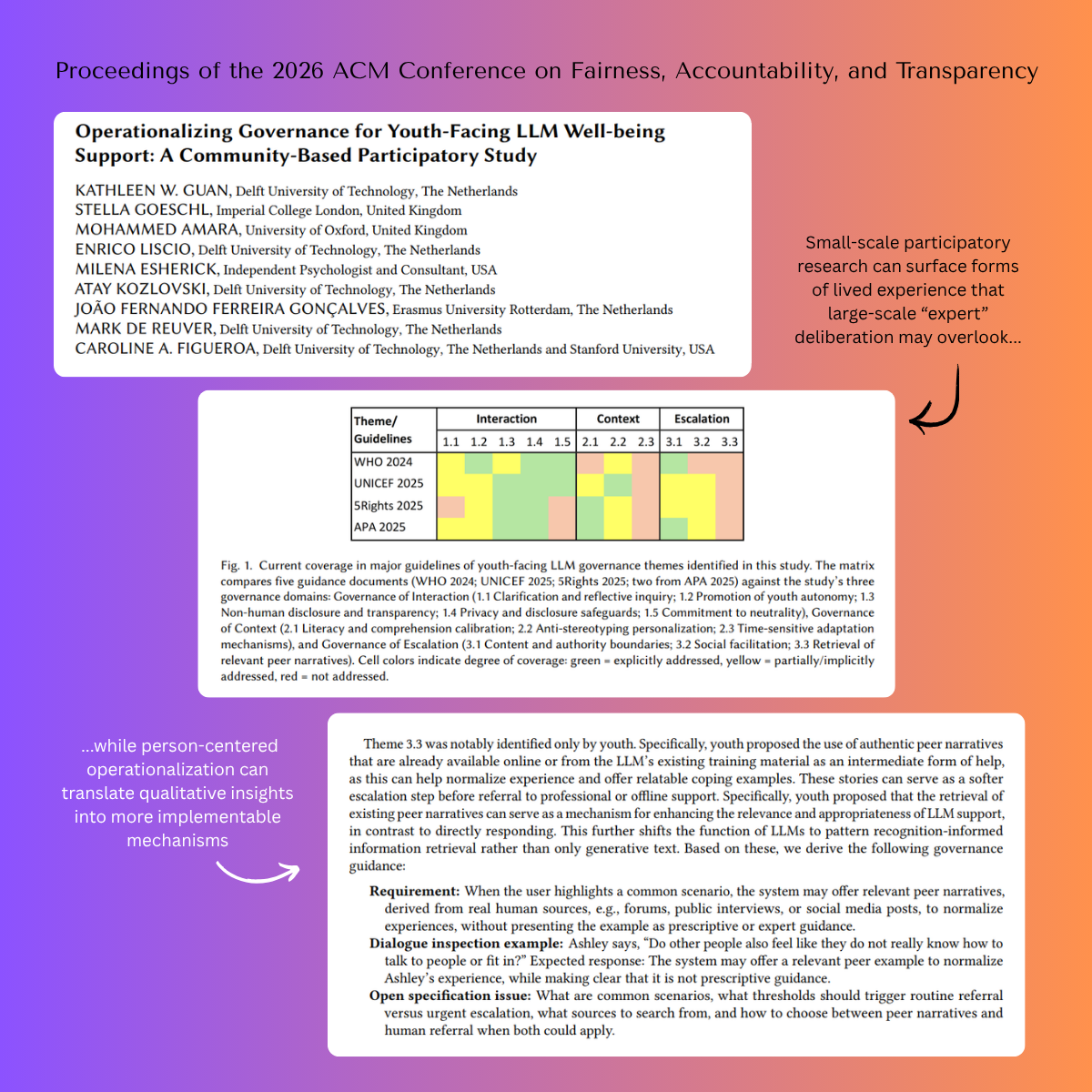
At #FAccT2026, I presented our participatory approach to operationalizing governance for youth-facing LLMs.
Escalation generated especially thoughtful discussion. Parents and social workers often emphasized boundaries, authority limits, and referral to human support. Young people proposed intermediary strategies, including retrieval-based ways to surface peer support stories before formal help. For youth-facing AI, safety may not always mean removing steps between a young person and formal help. Perhaps 𝘵𝘩𝘦 𝘪𝘯𝘵𝘦𝘳𝘮𝘦𝘥𝘪𝘢𝘵𝘦 𝘴𝘵𝘦𝘱𝘴 𝘮𝘢𝘺 𝘣𝘦 𝘸𝘩𝘢𝘵 𝘮𝘢𝘬𝘦 𝘩𝘦𝘭𝘱 𝘱𝘰𝘴𝘴𝘪𝘣𝘭𝘦.
𝐖𝐡𝐚𝐭 𝐫𝐞𝐦𝐚𝐢𝐧𝐬 𝐮𝐧𝐫𝐞𝐬𝐨𝐥𝐯𝐞𝐝
I'm very grateful to my co-authors for trusting me to represent our joint work, and to the conference communities for such thoughtful conversations!
I’m super curious to hear others’ perspectives: 𝘏𝘰𝘸 𝘤𝘢𝘯 𝘱𝘢𝘳𝘵𝘪𝘤𝘪𝘱𝘢𝘵𝘪𝘰𝘯 𝘣𝘦𝘤𝘰𝘮𝘦 𝘴𝘱𝘦𝘤𝘪𝘧𝘪𝘤 𝘦𝘯𝘰𝘶𝘨𝘩 𝘵𝘰 𝘮𝘢𝘵𝘵𝘦𝘳, not only as a broad principle, but in how responsibility, trust, autonomy, and care are distributed between young people, adults, institutions, and AI systems?